Image 1 of 1
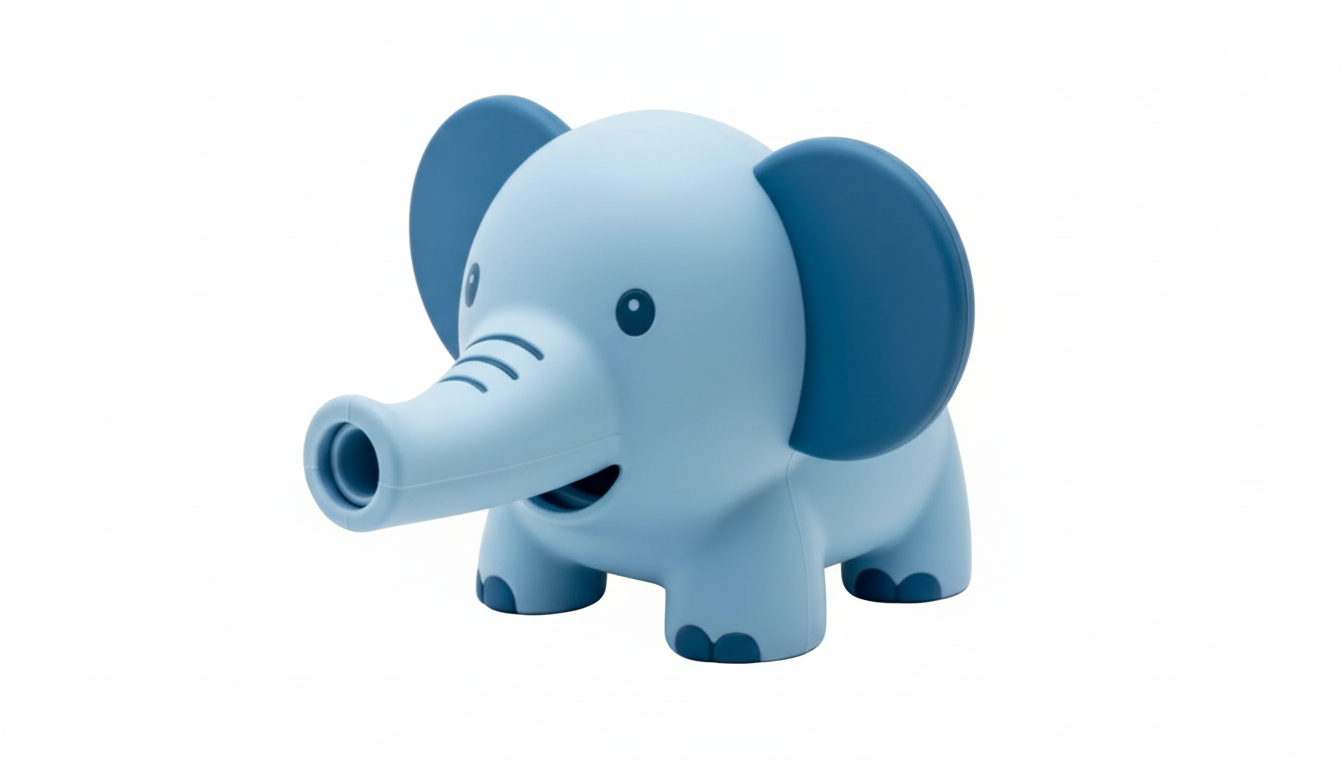
Play Forest faucet cover
size
Dimension (L x W x H): 15 cm x 10 cm x 2 cm
Material
Main body & ears: Food-grade PP plastic – strong, smooth, heat-resistant
Trunk spout + stretchable ring: Soft TPE (silicone-like rubber) – flexible and safe
Blue details (ears, feet, eyes): Non-toxic water-based paint / over-molded soft TPE
100 % BPA-free, phthalate-free, no smell, certified safe for drinking water contac
Production Steps
Raw material preparation – White and blue PP pellets + soft TPE are dried and pre-colored in separate barrels.
Two-color injection molding – First shot: white PP forms the elephant body in a high-precision steel mold; second shot: blue TPE is over-molded onto ears, feet, and inner ring in the same cycle (rotary mold system).
Cooling – Mold is water-cooled for 25–30 seconds until all plastic fully solidifies.
Automatic ejection & flash removal – Robot arm opens mold, ejects the elephant, and a blade trims any excess plastic.
Pad printing – Small black eyes and mouth details are printed using food-safe ink.
Quality checks – Workers stretch the ring 50–100 times to test elasticity, run water through the trunk to check flow, and inspect for cracks or color bleeding.
Final cleaning & packing – Pieces are washed, air-dried, placed into individual PE bags (usually 1–2 pcs per pack), then boxed for shipping.
size
Dimension (L x W x H): 15 cm x 10 cm x 2 cm
Material
Main body & ears: Food-grade PP plastic – strong, smooth, heat-resistant
Trunk spout + stretchable ring: Soft TPE (silicone-like rubber) – flexible and safe
Blue details (ears, feet, eyes): Non-toxic water-based paint / over-molded soft TPE
100 % BPA-free, phthalate-free, no smell, certified safe for drinking water contac
Production Steps
Raw material preparation – White and blue PP pellets + soft TPE are dried and pre-colored in separate barrels.
Two-color injection molding – First shot: white PP forms the elephant body in a high-precision steel mold; second shot: blue TPE is over-molded onto ears, feet, and inner ring in the same cycle (rotary mold system).
Cooling – Mold is water-cooled for 25–30 seconds until all plastic fully solidifies.
Automatic ejection & flash removal – Robot arm opens mold, ejects the elephant, and a blade trims any excess plastic.
Pad printing – Small black eyes and mouth details are printed using food-safe ink.
Quality checks – Workers stretch the ring 50–100 times to test elasticity, run water through the trunk to check flow, and inspect for cracks or color bleeding.
Final cleaning & packing – Pieces are washed, air-dried, placed into individual PE bags (usually 1–2 pcs per pack), then boxed for shipping.