
 Image 1 of 1
Materials
ABS (Acrylonitrile Butadiene Styrene): Lightweight, impact-resistant, dimensionally stable, and fully compatible with decorative electroplating surface treatment — the standard substrate for premium decorative hardware and consumer electronics exterior components
Surface Finish — Brushed Nickel Electroplating
Multi-layer electroplating: copper base coat for surface levelling + semi-bright nickel for corrosion resistance + bright nickel for reflectivity + satin nickel top coat
Brushed nickel finish: directional linear brush texture applied uniformly across all exterior faces prior to final sealing — producing a consistent warm satin metallic sheen
Resistant to UV exposure, humidity, and daily contact wear under normal indoor use conditions
Hinge & Assembly Interface
Rear hinge mount bosses machined or formed to accept standard notebook screen hinge hardware
Internal structural ribs maintain panel rigidity and prevent flex or drumming during transport and use
Precision parting line geometry at front edge for consistent gap control against base unit
Note: Overall dimensions, wall thickness, corner radius, hinge mount geometry, antenna window cutout, logo aperture, and surface finish are all fully customizable for OEM notebook brand and consumer electronics contract manufacturing supply.
Key Advantages
Aerospace-Grade Aluminium Construction — 6061-T6 aluminium alloy delivers the optimal combination of low weight, high panel stiffness, thermal conductivity, and machinability required for a premium notebook outer housing, meeting the structural and thermal performance benchmarks of leading ultrabook product lines.
Permanent Anodised Surface — Unlike paint or PVD coatings applied on top of the substrate, anodising converts the aluminium surface itself into a hard oxide layer — making it chemically bonded, impossible to peel or flake, and significantly more resistant to scratching, chipping, and corrosion over the full product lifespan.
Premium Brushed Aesthetic — Fine directional satin brush texture applied prior to anodising produces a consistent, uniform grain across the entire lid face — delivering the high-end ultrabook visual identity associated with premium consumer electronics brands at retail and in professional environments.
Fingerprint-Resistant Satin Surface — Fine satin brush grain diffuses reflected light across the lid top face, significantly reducing the visibility of fingerprints, palm contact marks, and surface smudges compared to polished or glossy aluminium finishes.
Lightweight Structural Performance — 6061-T6 aluminium at 0.8 – 1.2 mm wall thickness delivers the panel rigidity required to protect the display assembly from flex and impact loading during daily transport, at a weight contribution of approximately 180 g for a 14-inch format lid.
Full OEM Customization — Overall dimensions, wall thickness, corner radius, hinge mount geometry, antenna window, logo cutout or embossed logo area, colour anodising, and surface texture can all be specified for exact notebook model and brand requirement.
Key Features
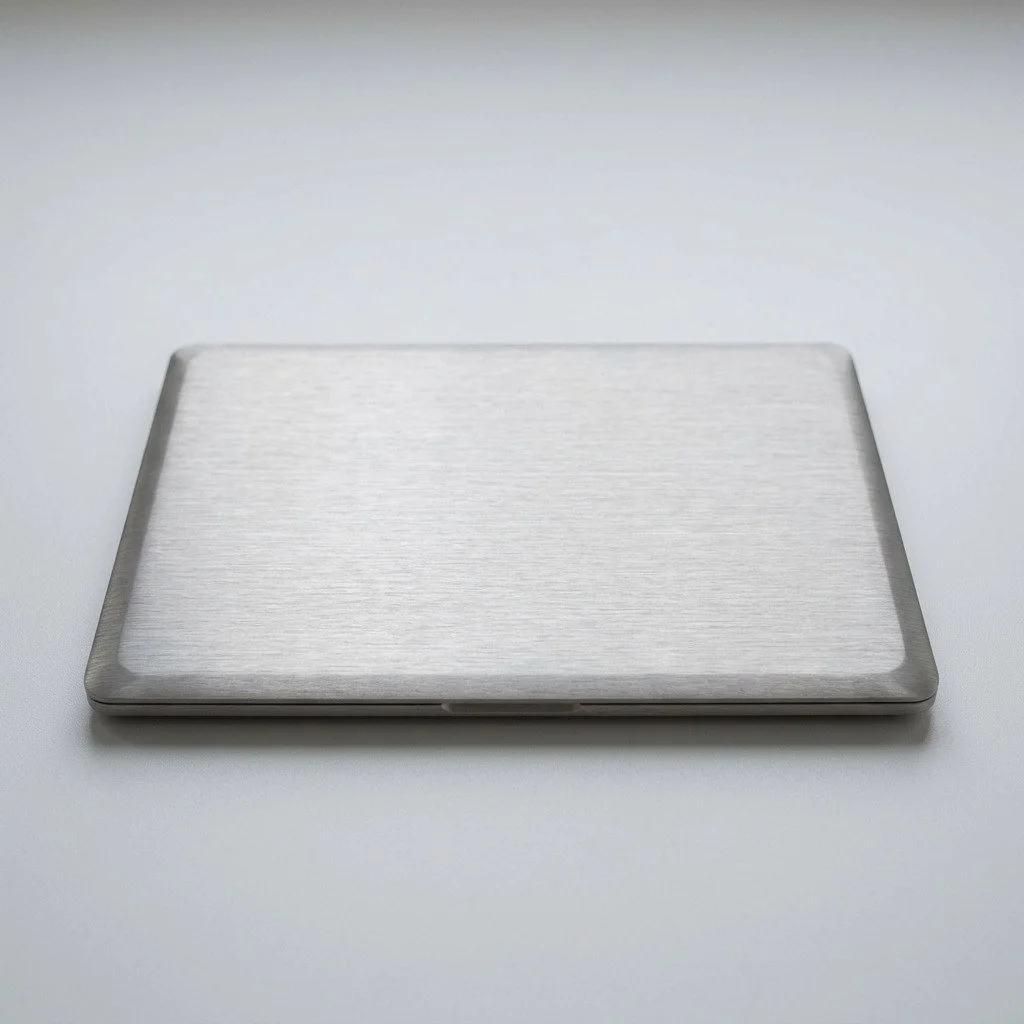
Wide flat top panel face — consistent wall thickness, no surface undulation
Uniformly deep radiused corners on all four edges — soft, premium tactile profile
Directional linear brushed satin finish across full top face and side walls
Hard anodised surface — approx. 10 – 15 μm oxide layer, permanently bonded
Fingerprint-resistant fine satin brush texture
Precision front-edge parting line for flush lid-to-base closure
Internal rear hinge mount bosses for screen hinge integration
Internal structural ribs for panel rigidity and display protection
Aluminium Alloy 6061-T6 — lightweight, high-strength, thermally conductive
Weight: approx. 180 g (14-inch format)
Full OEM dimension, geometry, and finish customization available
Manufacturing Process
Forming — Aluminium alloy 6061-T6 sheet is formed via CNC machining, die casting, or stamping depending on volume and tolerance requirements, producing the lid shell with consistent wall thickness, accurate corner radius geometry, and precisely positioned internal hinge mount and rib features.
CNC Finishing — Parting line edges, hinge mount bosses, and any port or antenna window cutouts are finish-machined to tight dimensional tolerances for accurate assembly fit against the notebook base unit and screen hinge hardware.
Mechanical Brushing — Directional linear brush texture is applied uniformly across the full exterior top face and side wall surfaces using controlled abrasive belt or rotary brushing, producing a consistent fine satin grain with uniform texture depth and direction across the entire panel.
Pre-Anodise Cleaning — Parts undergo multi-stage alkaline cleaning, acid etching, and deoxidising treatment to remove machining oils, surface oxides, and contamination, preparing a chemically clean aluminium surface for uniform anodise penetration.
Anodising — Parts are anodised in a sulphuric acid electrolyte bath at controlled current density and temperature, growing a hard, transparent aluminium oxide layer of 10 – 15 μm uniformly across all surfaces including brushed areas, recesses, and edge transitions.
Sealing — Anodised parts are sealed in hot deionised water or nickel acetate solution to close surface pores and maximise corrosion resistance and colour consistency across the batch.
Dimensional & Appearance Inspection — Every batch undergoes dimensional verification of overall size, wall thickness, parting line gap, and hinge mount position, plus visual inspection of brush texture consistency, anodise colour uniformity, and surface defect absence before shipment.