
 Image 1 of 1
Materials
ABS (Acrylonitrile Butadiene Styrene): Lightweight, impact-resistant, dimensionally stable, and fully compatible with decorative electroplating surface treatment — the standard substrate for premium decorative hardware and consumer electronics exterior components
Surface Finish — Brushed Nickel Electroplating
Multi-layer electroplating: copper base coat for surface levelling + semi-bright nickel for corrosion resistance + bright nickel for reflectivity + satin nickel top coat
Brushed nickel finish: directional linear brush texture applied uniformly across all exterior faces prior to final sealing — producing a consistent warm satin metallic sheen
Resistant to UV exposure, humidity, and daily contact wear under normal indoor use conditions
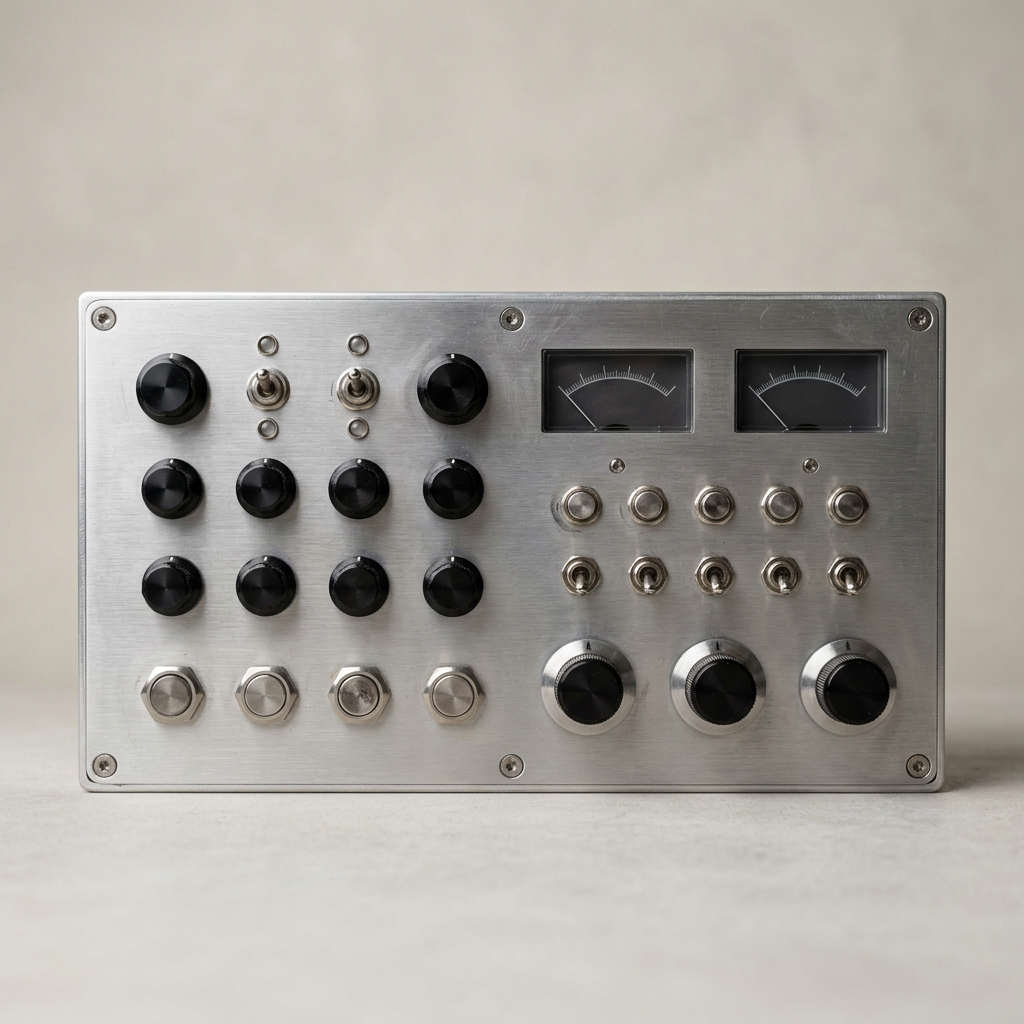
Apertures & Cutouts (standard layout)
12 × rotary potentiometer / encoder holes (left section)
4 × toggle switch slots (top section)
4 × LED indicator holes (top section)
2 × rectangular analogue VU meter cutouts (top right section)
8 × toggle switch slots (right mid section)
4 × push-button / momentary switch apertures (bottom left)
3 × large rotary knob holes (bottom right)
8 × countersunk M3 screw fixing holes at panel perimeter
Note: All overall dimensions, panel thickness, aperture type, count, position, and surface finish are fully customizable for OEM electronic equipment, audio hardware, and industrial instrument front panel supply.
Key Advantages
Professional Instrument Aesthetic — Brushed satin aluminium finish with dense, functional control layout delivers the authoritative visual character of high-grade audio amplifiers, mixing consoles, laboratory instruments, and industrial process controllers — a deliberate design language that communicates precision and reliability at first sight.
Full CNC Aperture Precision — Every rotary hole, toggle slot, meter cutout, and indicator aperture is CNC-machined to tight dimensional tolerances, ensuring accurate component fit, flush bezel seating, and consistent gap control across the full panel layout without secondary hand-finishing.
Permanent Hard Anodised Surface — Natural clear anodising converts the aluminium surface into a chemically bonded oxide layer — providing scratch, abrasion, and handling wear resistance far exceeding paint or PVD alternatives, essential for front panels subject to continuous knob and switch operation in professional environments.
Rigid, Stable Panel Structure — 6061-T6 aluminium at 2.0 – 3.0 mm panel thickness provides the structural rigidity required to resist flex and vibration under continuous knob-turning, switch toggling, and button pressing loads without panel deformation or component misalignment over time.
Dense Functional Layout Capability — CNC machining enables arbitrary aperture size, shape, and position across the full panel face with no minimum spacing constraints — accommodating the highest-density control layouts required by professional audio and instrumentation hardware without tool change or secondary operations.
Full OEM Customization — Panel dimensions, aperture layout, component cutout geometry, fixing pattern, surface finish colour, and silkscreen or laser engraving labelling can all be specified for exact electronic equipment, audio hardware, and industrial instrument front panel requirements.
Key Features
Flat rectangular brushed aluminium panel — 6061-T6, approx. 2.0 – 3.0 mm thickness
Full CNC-machined aperture layout: rotary holes, toggle slots, meter cutouts, LED holes, push-button apertures
Fine directional brushed satin texture across full panel face
Natural clear hard anodised finish — approx. 10 – 15 μm, permanently bonded
Fingerprint-resistant satin surface
Corner and perimeter countersunk M3 screw fixing holes
All aperture edges deburred and chamfered for flush component bezel seating
Rear face flat and square for accurate chassis mounting
Suitable for audio amplifiers, mixing consoles, signal processors, laboratory instruments, industrial controllers, and custom electronic enclosures
OEM aperture layout, dimensions, finish, and labelling customization available
Manufacturing Process
CNC Machining — Aluminium alloy 6061-T6 sheet stock is fixtured and machined in a single CNC setup covering all apertures, cutouts, fixing holes, and panel perimeter geometry — ensuring accurate relative positioning between all features without repositioning error.
Deburring & Edge Treatment — All machined aperture edges, fixing hole chamfers, and panel perimeter edges are deburred and hand-finished to remove sharp edges and ensure flush component bezel seating and safe panel handling.
Mechanical Brushing — Fine directional linear brush texture is applied uniformly across the full front panel face using controlled abrasive belt or pad tooling, producing a consistent fine satin grain aligned with the long axis of the panel.
Pre-Anodise Cleaning — Panels undergo multi-stage alkaline cleaning, acid etching, and deoxidising to prepare a chemically clean aluminium surface for uniform anodise penetration and consistent finish appearance.
Natural Clear Anodising — Panels are anodised in a controlled sulphuric acid electrolyte bath to grow a 10 – 15 μm transparent oxide layer, preserving the natural aluminium colour while permanently hardening the surface.
Sealing — Anodised panels are sealed in hot deionised water to close surface pores and maximise corrosion resistance and finish consistency.
Optional Laser Engraving / Silkscreen Labelling — Control function labels, scale markings, brand name, and model designation are applied by laser engraving or silkscreen printing post-anodise as specified per OEM order.
Dimensional Inspection — Every batch undergoes dimensional verification of panel size, aperture positions, fixing hole alignment, and thickness before shipment.