
Understanding Corrosion Resistance: Why CASS & Salt Spray Testing Matter for Sanitary Hardware
The performance and longevity of sanitary hardware—such as showerheads, faucets, and bathroom fixtures—are heavily determined by the durability of their surface finishes. Bathrooms are notoriously hostile environments characterized by high humidity, constant water contact, elevated temperatures, and exposure to aggressive cleaning chemicals. Without rigorous quality control, chrome, nickel, or physical vapor deposition (PVD) coatings can quickly pit, peel, or rust.
To ensure products withstand these harsh real-world conditions, manufacturers rely on standardized accelerated corrosion testing: Neutral Salt Spray (NSS) testing and Copper-Accelerated Acetic Acid Salt Spray (CASS) testing.
The Reality of Bathroom Corrosion
Corrosion in sanitary hardware occurs when moisture, oxygen, and corrosive ions (such as chlorides present in tap water or cleaning solutions) penetrate microscopic pores or imperfections in the electroplated coating. Once these agents reach the underlying substrate—typically brass, zinc alloy, or stainless steel—an electrochemical reaction begins:
Galvanic Corrosion: Dissimilar metals (e.g., a copper/nickel sublayer beneath a chrome topcoat) interact in the presence of an electrolyte, accelerating substrate oxidation.
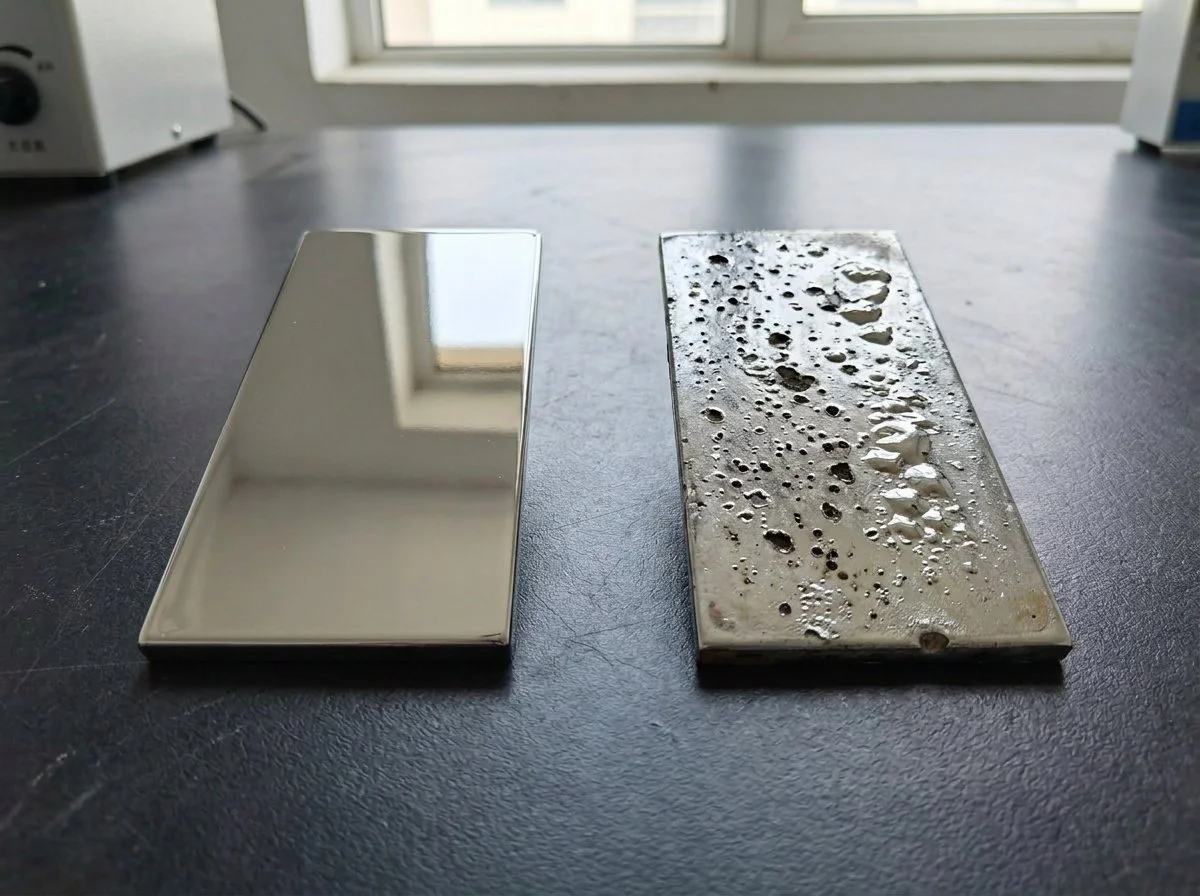
Pitting Corrosion: Microscopic voids in the plating lead to localized, deep pits that undermine structural integrity and cause surface flaking
Blistering & Peeling: Oxidation beneath the plated layer expands, causing the top coat to bubble and detach.
Understanding the Tests: NSS vs. CASS
Accelerated corrosion tests simulate years of environmental exposure within a condensed timeframe inside an environmental chamber.
1. Neutral Salt Spray (NSS) Testing
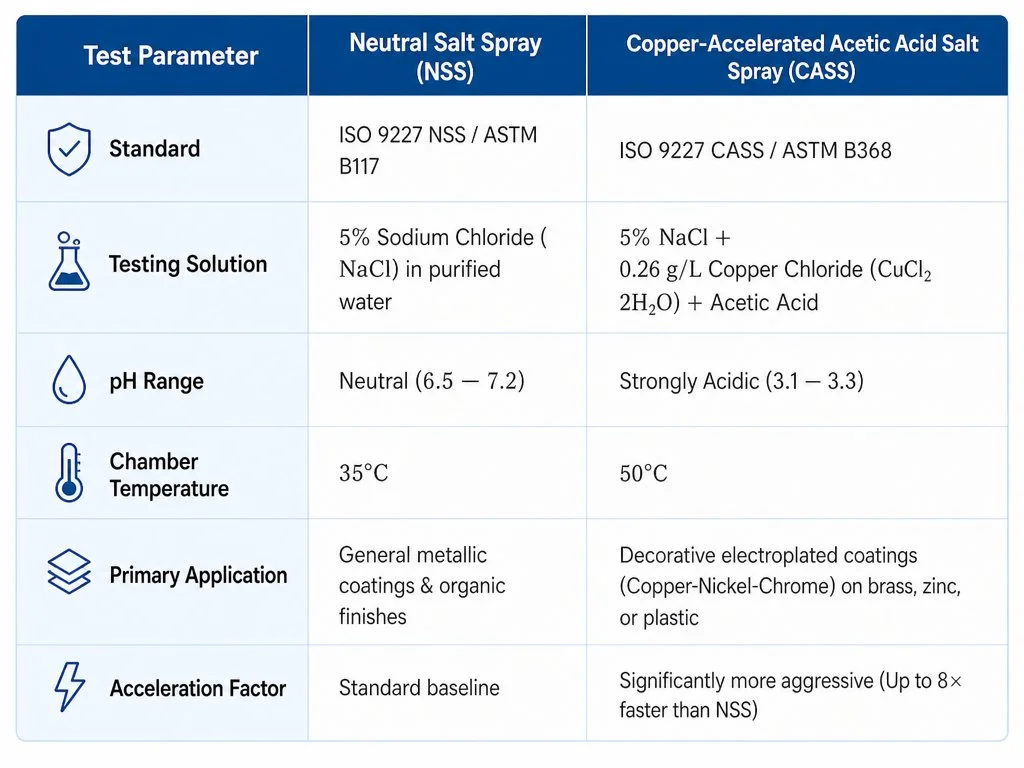
NSS is the foundational industry standard. The test subject is continuously atomized with a neutral 5% saline mist at 35°C. It provides a solid baseline for general corrosion resistance, verifying that basic barrier layers are intact and free of macro defects.
2. Copper Accelerated Acetic Acid Salt Spray (CASS) Testing
CASS is specifically engineered for high performance decorative plating, such as multi layer copper nickel chromium coatings. By adding cupric chloride (CuCl₂) and lowering the pH to 3.1 – 3.3 with acetic acid at an elevated temperature of 50°C, the solution aggressively attacks potential weak points.
A 24 hour CASS test simulates several years of heavy exposure in a high humidity, corrosive bathroom environment.
Key Evaluation Criteria for Sanitary Hardware
After undergoing testing for a specified duration (typically 24, 48, or 96 hours depending on target quality tiers), samples are evaluated using standardized rating systems such as ISO 10289:
· Protection Rating (Rp): Measures the ability of the coating to protect the basis metal from corrosion.
· Appearance Rating (RA): Evaluates the visual deterioration of the topcoat (loss of luster, staining, or surface pitting).
· Blistering & Adhesion: Tested post spray via cross hatch/tape adhesion testing (ISO 2409) to confirm no inter layer delamination occurred during chemical stress.
A passing grade for premium sanitary hardware typically demands a Rating 9 or 10 (less than 0.1% total defect area) after a 24 hour or 48 hour CASS test.
Why Corrosion Testing Matters for Manufacturers & Buyers
Prevents Early Field Failures: Accelerated testing identifies micro-porosity, uneven plating thickness, or inadequate nickel sublayers before mass production starts.
Ensures Process Stability: Routine CASS/NSS testing acts as an indispensable Quality Assurance (QA) gate, verifying that electroplating bath chemistries, current densities, and cleaning pre-treatments remain within tolerance.
Guarantees Brand Reputation: Premium surface finishes are a direct indicator of product quality. Meeting rigorous CASS benchmarks ensures fixtures maintain their mirror-like reflectivity or matte aesthetics through years of daily use.
