
When you look at a shiny cosmetic cap, bathroom fitting or decorative plastic part, it is easy to think:
“That’s chrome.”
But the surface you see is often only the final layer.
Underneath that bright finish may be several different metal layers, each doing a different job. Think of electroplating a little like dressing a product in layers — one layer helps create a smooth base, another adds protection, and the final one creates the appearance you actually see.
So what do copper, nickel and chrome really do?
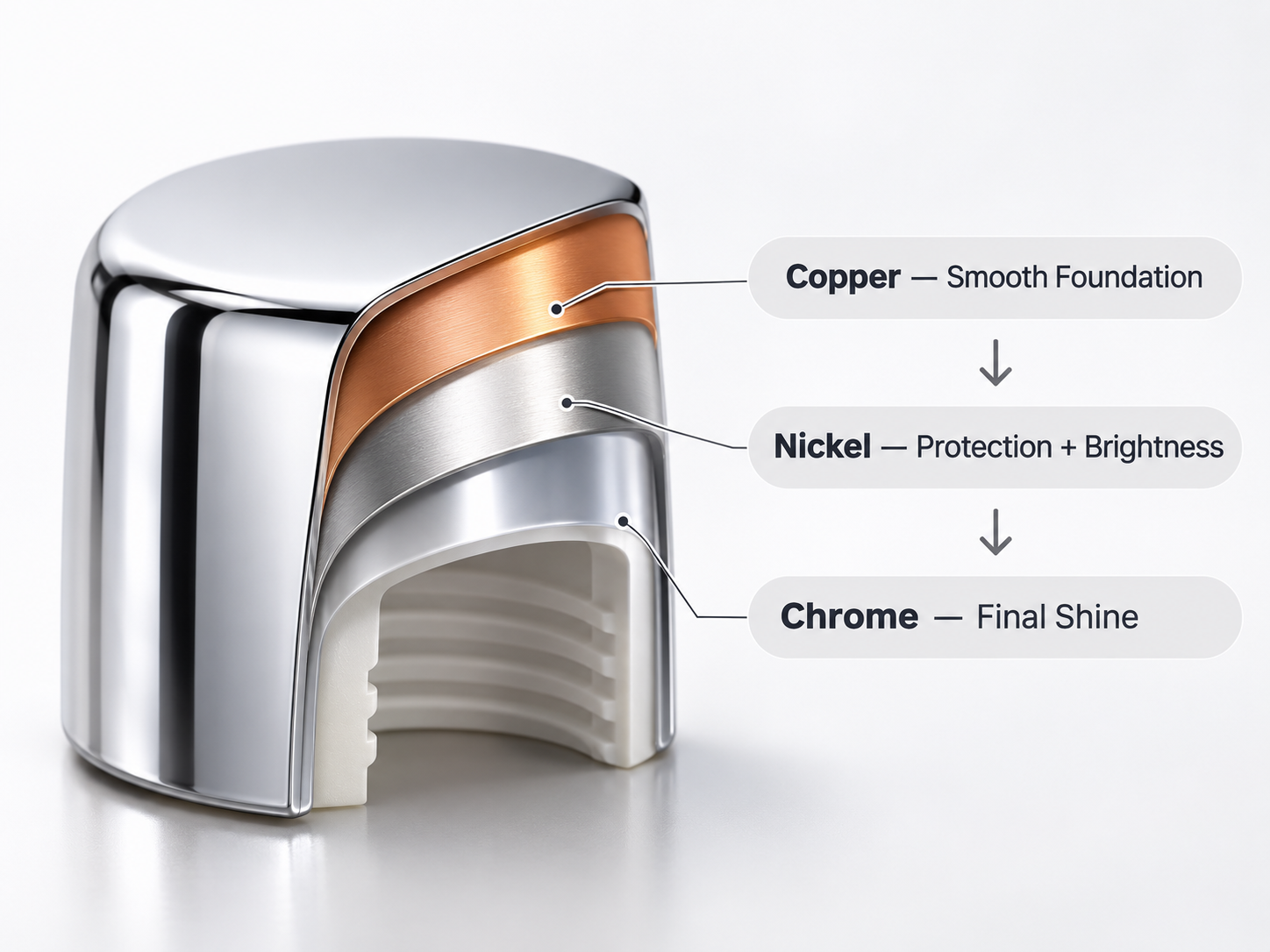
1. Copper: Creating a Better Foundation
Copper is often one of the important layers underneath the final finish.
Its job is not necessarily to be seen. Instead, it helps create a smoother and more even surface for the layers that come after it.
Imagine painting a wall. If the wall underneath is rough, even expensive paint will not look perfect. A good base makes the final surface look much better.
Copper plays a similar role in many electroplating systems.
It can help improve surface smoothness and provide a better foundation for subsequent nickel and chrome layers.
This is especially useful for products where appearance matters — such as cosmetic packaging, decorative components and bathroom accessories.
2. Nickel: The Hard-Working Middle Layer
If copper prepares the surface, nickel does much of the heavy lifting.
Nickel layers can contribute to corrosion resistance, surface durability and overall appearance. Depending on the required finish, different nickel layers may also be used together.
For example, a plating system may include both semi-bright nickel and bright nickel.
You do not normally see these layers separately when looking at the finished product, but they are an important part of what helps the surface maintain its appearance over time.
A simple way to think about it is:
Copper helps build the foundation.
Nickel helps provide protection and appearance.
3. Chrome: The Finishing Touch Everyone Recognizes
Chrome is usually the layer people notice first.
It creates the bright, clean, metallic appearance commonly associated with many premium consumer products.
But interestingly, the chrome layer itself is often much thinner than people expect.
Much of the smoothness and appearance has already been built by the layers underneath. Chrome provides the final surface character, helping create the familiar bright metallic look while also supporting surface resistance.
So when a product has a beautiful chrome finish, the result is not simply “because of the chrome.”
It is the entire plating system working together.
4. Why Not Just Use One Thick Layer?
This is a question customers sometimes ask.
If chrome looks good, why not simply make the chrome layer thicker?
Because different metals are good at different things.
Using multiple layers allows the plating system to combine different advantages instead of asking one material to do everything.
It is a little like making a sandwich.
The bread, filling and sauce all have different purposes. Adding more sauce does not replace the bread.
Electroplating works in a similar way.
A good plating structure is about choosing the right layers for the right job — not simply making one layer as thick as possible.
5. The Same Finish Can Be Used on Very Different Products
One of the interesting things about electroplating is how widely it can be used.
A metallic finish may appear on:
· cosmetic packaging and caps
· perfume components
· bathroom products
· household accessories
· appliance parts
· decorative plastic components
· lifestyle products
The finished products may look completely different, but the basic idea is similar: use surface treatment to improve appearance, create a more premium feel and meet the performance requirements of the product.
Of course, the exact plating structure will depend on the base material, product design, required finish and intended application.
There is no single plating recipe for every product.

6. Good Electroplating Is About the Whole System
When people talk about plating quality, they often focus only on the final color.
But a good finish starts much earlier.
Surface preparation, cleaning, etching, activation, copper plating, nickel plating, chrome plating and process control can all influence the final result.
A beautiful surface is therefore not created in the last tank.
It is built step by step.
At AQUAmate, our electroplating experience covers a wide range of products and applications. We work with customers on different product materials, structures and surface-finish requirements to develop practical plating solutions for production.
Whether the product is a bathroom component, cosmetic package or decorative consumer product, the goal is the same:
to create a finish that looks right, performs reliably and can be produced consistently.
Because when it comes to electroplating, the shine you see is only the final chapter.
The real story is in the layers underneath.
